

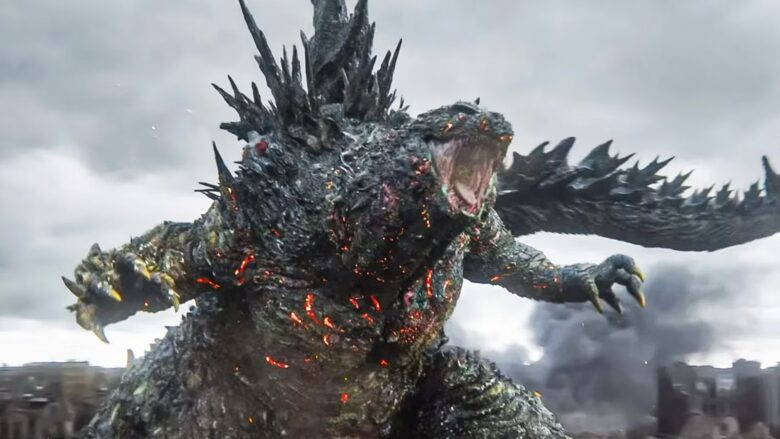
Godzilla contains multitudes.
The Japanese cultural juggernaut is both a spiky, bad-breath-spewing physical manifestation of humanity’s nuclear sins and also used to do kooky misadventures his nephew Godzooky in a cartoon that was rerun during my youth. Those of us who grew up on TV broadcasts of his movies, which had budgets equivalent to loose change in the couch, developed an affinity for the antiheroic beast and his motley assortment of adversaries. Those who didn’t do that don’t quite “get” the schizophrenic, bifurcated appeal of the adorable and terrifying monster.
Godzilla Minus One somehow captured the full (atomic) breadth and depth of the porky skyscraper destroyer. It was silly serious. It was melodramatically authentic. It was depressingly inspiring. Godzilla Minus Zero is, somewhat inexplicably, even better. It almost certainly won’t notch the same notoriety or acclaim. However, it will get at least one honorific from me. It’s the best kaiju movie I’ve ever seen. I would watch it again right now. A few times. Actually, brb.
The film is set in 1949, two years after the events of the previous film. Fallout from America’s real-life atrocities in Hiroshima and Nagasaki have combined with the fictional wrath of the gargantuan lizard to leave the nation reeling. They are sad, scared, and furious.
Kōichi Shikishima (Ryûnosuke Kamiki), the former kamikaze pilot who thought he killed Godzilla once already, married Noriko Ôishi (Minami Hamabe). They are raising Akiko (Sae Nagatani), their adopted daughter, amidst the rubble and chaos. Kenji Noda (Hidetaka Yoshioka), the lovely scientist who helped lead the response in Minus One, is now in charge of a bureau assembled to confront any other monster events, should they occur.
They do! Specifically, Ghidorah shows up. It looks like a dragon now but arrived on earth as a gross blob from space. Scientist Kanji Murakami (Min Tanaka), who watched his family die at Hiroshima, also survives Ghidorah’s destruction and helps to lead a response. As hard as it may be to believe, that response is strong-armed a bit by the Americans.
Seeing ties between the new creature and meteorological shenanigans, Makoto Aoyama (Masami Nagasawa) comes up with a plan B for if (when) the USA’s plan encounters a SNAFU. Said plan B involves Shikishima and others engaging in an arial dogfight with Ghidorah that is absolute perfection to watch. It also doesn’t work. In fact, it doesn’t work so hard.
The beast pops out a few new heads and gets more powers, leading his new form to be called “King Ghidorah.” The only thing that can stop him now? Any guesses? Who has no thumbs and a relative whose name rhymes with kooky? Resurrected Godzilla! (Godzilla Jesus?) As per usual, the strategy is “get the monsters to fight.” The means to do so is gloriously sci-fi gibberish and relies on Noriko’s mutations from her previous Godzilla exposure.
Everyone has (rightly) applauded writer/director Takashi Yamazaki’s ability to ground the kaiju-jitsu in human drama. What fewer have praised is his deftness in synthesizing goofiness and sobriety within any given scene and more broadly across both of his immaculate films. This is a movie in which Murakami (understandably) fantasizes in grotesque detail about using Godzilla against New York as revenge for Hiroshima. It is also one in which King Ghidorah’s triple heads look exactly as they do in a familiar meme.
Honestly, that could be what tipped me over from thinking this was a great Godzilla movie to thinking it is the best ever. The ear-ripping sounds and intense choreography are horrifying while still preserving the zany old-school designs. And although Minus One had a more uplifting message about unified resistance to impossibly gigantic threats, Minus Zero has a thematic through point that feels just as salient.
We joke routinely about living in unprecedented times and the relentless onslaught of previously unimaginable threats, from AI to rotting global institutions. Minus Zero is an acknowledgment of the exhaustion tucked inside a reminder to not lose humanity and surrender to our worst impulses. All that, and Godzilla fights King Ghidorah, if I didn’t make that clear. It is all any Godzillian could want.
Grade = A
Other Critical Voices to Consider
Amy Nicholson at the LA Times says “The people trying to save the day are never macho or quippy. They wear drab suits and work out of drab offices; the dramatic montages are of people working intently at their desks. When their plans go badly, they take full responsibility. When they succeed, they pause to honor everything sacrificed in the effort, and would find it barbaric if anyone dared to pump their fists.”
Meagan Navarro at Bloody Disgusting says “The first Japanese feature shot in IMAX is a technical marvel. But between all the action, stunning VFX work, and detail is a grounded treatise on the WWII trauma and the long-term catastrophic cost of nuclear power.”
Siddhant Adlakha at Joy Sauce says “as the camera dips and weaves through the air and entire houses fly at the camera, the film is a heart-in-mouth riot rendered with some of the finest special effects you’ll see this year. But when it finally sidesteps this storytelling mode, opting instead for large-scale fisticuffs, things don’t quite cohere.”