
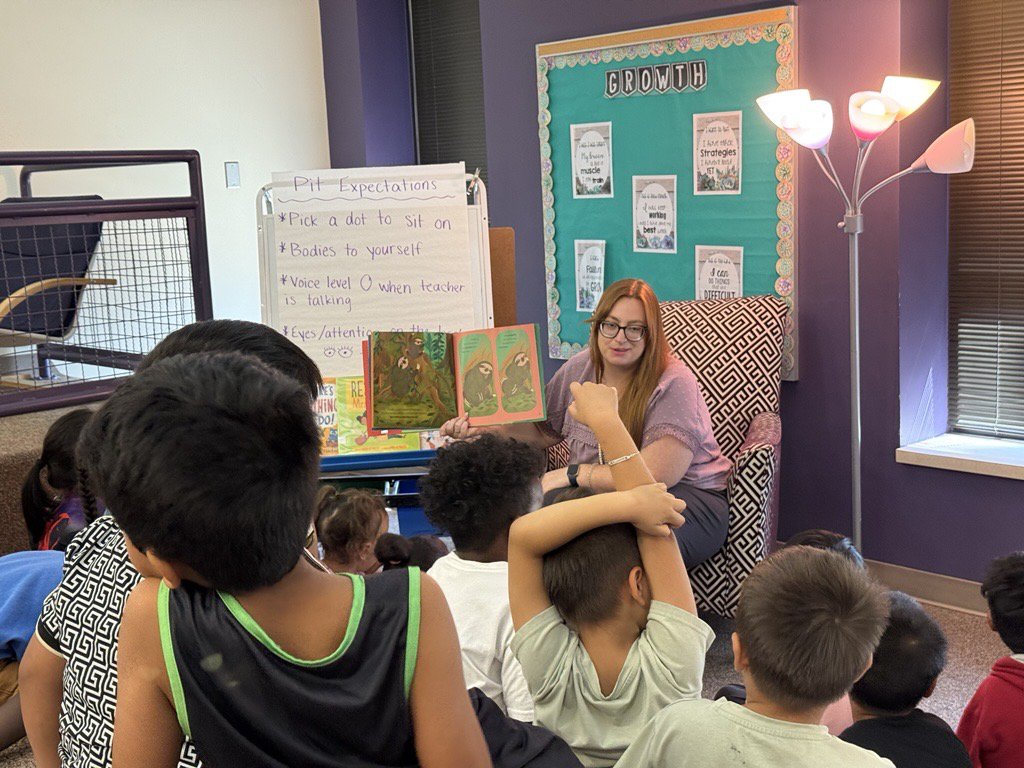

School librarian Karen Rickert reads a book about a sloth to a group of soon-to-be first graders at Kennedy Elementary in North Omaha. The students laugh and act disgusted at the part about the sloth trying to learn how to poop.
“I try to find silly books like the sloth book this morning, where the sloth is on a mission to poop,” Rickert said. “The kids were freaking out about it, but just trying to make reading fun for the students.”
This class of students was part of Next Level Learning, which is Omaha Public Schools’ summer school program. Students get library time once a week.
It’s one way the district is promoting reading during the summer, especially as OPS works to have all students reading at grade level by 2030, which leaders call their moonshot.
For students not enrolled in Next Level Learning, there are checkout periods every Wednesday in June from 10 a.m. to noon, along with a story time from 10:15-10:45 a.m. Any student in the district can check out books during that time and attend story time.
Rickert said reading during the summer break helps with retention and building vocabulary.
“The more you read, the more vocabulary words you know,” Rickert said. “With the district’s moonshot goal by 2030, it’s just super important for kids to keep being engaged with reading, so that they keep going and they don’t lose anything.”
Before the school year ended, the district also allowed each student to check out two books for the summer. Rickert said about 15,000 books went home with kids across OPS, which they can return at the start of next school year or during the summer checkout availability in June.
She added that through a partnership with Omaha Public Library, students enrolled in summer school also got two free books to keep.
“We’re also trying to encourage students to connect with the public library,” Rickert said.

The district also has a reading app called Sora where students can access all kinds of books, including chapter and picture books, audiobooks and comic books.
“The more variety, the more engagement you get, and the more you see students actually find something that they like,” Rickert said. “It’s so cool to watch them really connect with a book, and, like, ‘When’s the next one,’ or, ‘do you have this book,’ or, ‘I really like this book.’”
Rickert said she hopes students and families keep reading during the summer, whether it’s a picture book, listening to a book during a road trip or even reading road signs out loud.
“There’s lots of little ways to sneak reading in,” Rickert said. “Just keep reading.”