
When Carole Jeanpierre allows herself to consider all she has endured through five decades of life, the emotions — much like Jeanpierre — cannot be held back. “It moves me to tears,” she said.
The Omaha native has lived plenty of joy: a close and loving family; unwavering faith; and a singing career that has seen her back the likes of Michael Bolton and Reba McIntyre. But life also has delivered a heaping helping of heartbreak: severe childhood trauma; hardship as a single mother; the death of a child; a near-fatal car crash; cancer; and the realities of being a Black woman in the overwhelmingly white world of classical music and opera.
Somehow, she has kept her inner joy through it all, she says. “The challenges make me stronger. Besides, I have work to do.”
The work, in this case, is “Noalia: An Opera of Love,” a 23-year-old passion project that finally premieres Aug. 14 at the University of Nebraska at Omaha’s Strauss Performing Arts Center. The independently produced, two-act opera about sacrificial love is an artistic manifestation of the one thing Jeanpierre has never lacked: perseverance.
“Noalia” is both the vision of one woman and an ambitious family affair featuring three generations of her classically trained family. Jeanpierre conceived the story, wrote the script (also called a libretto) and scored the music. For good measure, she’s also its designer, costumer, producer and craft services person.
Jeanpierre first conceived “Noalia” in 2003. It came in a dream, she said. Her mother, Nola Jeanpierre, watched as each song developed and the story came together piece by piece. The characters possess elements from people in Carole Jeanpierre’s life, said the elder Jeanpierre, who plays Queenie, a role inspired by Nola’s own grandmother.Moments in the play mirror real life, such as the opening scene, which takes place in a cemetery after a funeral. Carole Jeanpierre — a powerful vocalist capable of seamlessly moving from classical to gospel, R&B, soul, jazz and pop — often gets asked to sing at funerals. She has lent her expressive voice to solemn services more times than she can count.
One reason the opera was so long in progress stemmed from Carole’s desire to do it herself, said Nola Jeanpierre, a respected vocalist in her own right who has served as featured singer at the St. Cecilia Flower Festival since its inception.
“I think she felt if she released that to someone else too much it would lose its meaning, particularly to her,” Nola said. “She’s had to nurture it herself — each scene, each character, each song. So it has been an undertaking.”

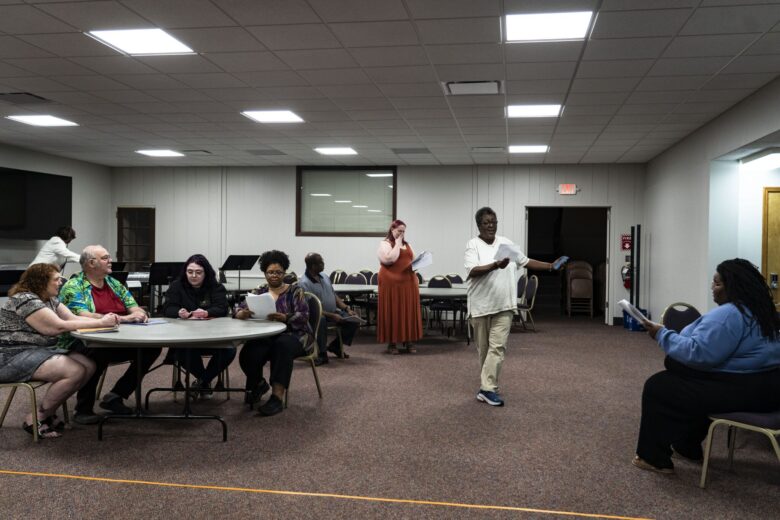
The undertaking was evident during a March 2025 rehearsal, before its planned spring debut got pushed back. Over the last year, events again compelled her to postpone the opera’s premiere.
On the purple Lenten-cloaked altar at Church of the Resurrection in North Omaha, Carole, some cast members, musicians and visitors joined hands in prayer to bless the project. Then, at the piano, she gently asked her two leads to “spark.”
Carole’s daughter Elyssia Reschelle Finch, as the titular Noalia, took instructions in stride. Cousin Quentin King, then cast as her romantic interest, found his part’s sliding scale from baritone to falsetto with Jeanpierre’s patient coaching. An organ player underlined the melody while a keyboardist added “decoration,” the music variously echoing Mozart, gospel and jazz.

The only person missing that March night was Nola Jeanpierre, who was in Los Angeles tending to funeral arrangements for a relative to whom she had provided end-of-life care. Caregiving is a Jeanpierre tradition.
At the rehearsal, folks feasted on salmon croquettes, greens, mac and cheese and peach cobbler — all prepared by Carole Jeanpierre. Jeanpierre’s an equally generous host at her midtown apartment, which also serves as music studio, rehearsal space, community enrichment center and church.
Along with more recent events and her desire to helm the creative process, life has conspired to delay “Noalia.”
She had no voice left to sing after the death of her 34-year-old son, Emil J. Finch, last year from a brain embolism. It was another marker in “Noalia” having sprung, Carole said, “from a lot of things broken around me.”
When she was a young child, Carole Jeanpierre said, she was molested. As a teen, she said, she survived a gang rape. Faith and forgiveness helped her heal, as did art. “Noalia” emerged from the pain. “God started writing my hand. The words came first in poetic fashion. Then I started going to the keyboard to find out how it should sound.”

Her project got sidelined in 2011 when she suffered severe injuries in a car accident. After seven hours of emergency spinal surgery, she was left immobile and mute. “For two years, I had to sit and watch everyone else sing around me, and it ate me up on the inside because I wanted it.”
After years of physical therapy, she regained her mobility and her voice, only to confront a breast cancer diagnosis in 2019. Chemo robbed her of her singing voice. Getting her instrument back took months, and she still lives with the aftereffects, she said. “I have a team of doctors around me so that I can continue to hold a mic.”
Then there is the racial reality of the world of opera and classical music. Only 2% of orchestra musicians in 2025 identified as Black, according to a survey by the League of American Orchestras. Meanwhile, a survey of 28 U.S. opera companies for the 2025-26 season found that while the percentage of Black cast members largely matched the overall U.S. population, the numbers plummeted when it came to conducting and directing, with less than 5% of conductors and directors identifying only as Black.
“She’s been working years to see the opera come to fruition,” daughter Finch said, “and that’s years of hearing ‘No, not interested’ and having many doors closed in her face.”

Some artists are breaking through with operas that give voice to the Black experience. In 2023, Opera Omaha co-produced and premiered a new version of “X” by librettist Thulani Davis and composer Anthony Davis. In 2025 came the Kennedy Center premiere of both “The Seer” and “Future of Dreams,” both by Black writers and composers. The productions commissioned Black designers and directors.
Where each of those works resulted from a collaboration between a composer and librettist, Jeanpierre created both the music and words for “Noalia,” thus making it a self-authored opera. If “Noalia” catches on, it could put Jeanpierre in a league of her own among contemporary opera creators.
It’s rare for any individual to write both the libretto and score, much less serve as their work’s own producer and designer, said Hal France, former artistic director at Opera Omaha. Jeanpierre also performs in it.

“She is doing it all,” he said admiringly. “To do every single piece, and a Black woman doing it, gives me such pride,” Nola Jeanpierre chimed in.
Over time, Carole has staged glimpses of “Noalia” at New Life Presbyterian Church. France saw the excerpts and came away impressed. “The music is very melodic and tonal coming from a gifted composer-singer. The story struck me as a deeply personal one that channels life experience, memory and identity. I’m excited to see the full opera brought to life.”
There has been no support from major institutions, thus this passion project is largely self-financed. Carole has pressed on anyway, acquiring new skills and finding donors and partners as needed. She has leaned into a diverse group of artists for their mentoring and encouragement, including a pair of ministers of music: Matt Walker (Clair Memorial United Methodist Church) and Delores Matthews (Zion).
Her cousin VJ Orduna, artistic director at the Omaha Community Playhouse, is co-directing with Finch. A whole cast of creative people have aided in the production.
“‘Noalia’ is so much bigger than me,” Carole said. “It has to come out because it’s from the heart and it will bless people.”
Getting to this point, she says, has been exhausting. “Yet a new burning desire hit me when I thought about what ‘Noalia’s’ message is about — love being exampled and exemplified as the greatest gift.”
No one is happier for her than her family. “It’s a joy to see a Black woman fulfill a dream, it really is,” Nola said.
Doors open at 7 p.m. Aug. 14. Free tickets can be reserved by emailing Carolefrenche1@gmail.com. Carole is waiting to see how “Noalia” is received before weighing offers she has to produce it again and to perhaps even tour it. For now, she is happy her dream is finally taking the stage.
“It’s been a long time coming,” she said.
The Flatwater Free Press is Nebraska’s first independent, nonprofit newsroom focused on investigations and feature stories that matter.