

Fitting, given that Homer is listed on its IMDB page: Christopher Nolan’s The Odyssey finally settles an age-old question. In a shocking turn of events, acting is important for movies!
Perhaps no cinematic fact has been shouted in my general direction more than the fact that the film is the first of its kind to be “entirely shot” in IMAX. IMAX cameras apparently need to be reloaded every 3 minutes or so. Actors do not! This resulted in a breathtakingly stunning movie with performances that range from awful to “almost okay.” The other big criticism is that Nolan still fundamentally doesn’t understand what motivates women to do…literally anything. We’ll get there.
To not bury the lede too far: The Odyssey is not Oppenheimer, in that it did not inspire a furious rage that has yet to subside. It is good. Nay. Dare I say, it is pretty darn good! The decision to Americanize the dialect was great. The pace was truly incredible, and the story was even told somewhat in order, which probably gave Nolan the ick. Everyone seemingly agrees upon its good-to-very-goodness, even if it is mystifying to think of watching it a second time.
Hey, do you need a synopsis? A synopsis of The Odyssey, one of if not the most retold stories of all time? Do you mind if we just skip that here and break down the stuff that worked and stuff that didn’t, given the plot has been floating around for thousands of years? Cool. Thanks.
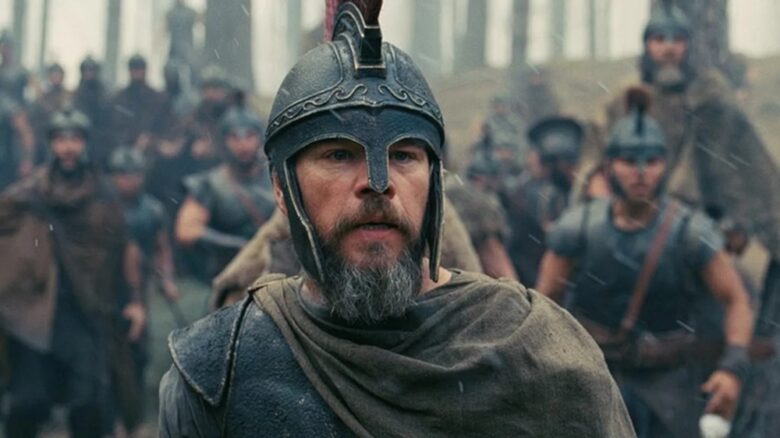
Matt Damon is fully serviceable as Odysseus. He feels like the safest possible choice for the role and brings no unique spin to it. Same for Anne Hathaway as Penelope, who weeps and gnashes her teeth. And for Tom Holland as Telemachus, who just feels like the nicest guy, even here. As one of Penelope’s would-be suitors, Antinous, Robert Pattinson comes as close as anyone can to giving an actual performance.
It is just so palpably weird to watch. Each performer gives one single emotion at a time, unable to flow through the interconnected circuit of emotions humans actually feel at verbal or visual stimuli. This is fine when they’re running from one-eyed giants and less fine when having conversations. And if you thought adapting an impossibly-well-known text would prevent chunks of spoken exposition, you don’t know Nolan.
However, the exposition here is…good? Most of it is Odysseus revealing the secret emotional burden he’s been carrying since the Trojan War. His dialogue-heavy explanation is stunted and stilted for reasons addressed above, but the gist of it is actually remarkably insightful. For me, it felt less like a coda to the themes of Oppenheimer, as many have been suggesting, and more like a do-over. This explicit condemnation of regretted decisions and glum look forward is somehow more relevant and salient than anything in the far-more-modern bomb-making biopic.
There may be no nuclear blast here, but the mythological mayhem is far more spectacular. Literally every memorable magical encounter on Odysseus’ ill-fated trip is next-level remarkable. Perhaps none more so than when the seafarers are ravaged by the Cyclops. No one can say for sure what an actual run-in with a colossal, mono-visioned beast would “really” look like, but this is probably what it would really look like. Smaller situations, like the simple sorcery of Circe (Samantha Morton) and the sirens’ song, pop just as much as the battle with the Scylla, who is essentially a Greek Kaiju.
What doesn’t pop is, go figure, Nolan’s handling of the film’s women. They are mostly absent. Seriously, Mia Goth shows up for like 2 lines of dialogue. She barely gets to do her cuckoo-bonkers face/voice! More frustrating than screentime is the way that the film folds on top of itself to explore the motivations of every minor male figure and can’t seem to bother with speculating why, say, Calypso (Charlize Theron) would have been inspired to kidnap Odysseus for almost a decade and whether she feels bad about that or not. Theron goes for a consistent, near monotone performance that stands among the best but reveals nothing about her feelings.
Because ultimately, as a Christopher Nolan film, this must never waver from exploring The Burden of Great Men™. It is better than many of his other stabs at this wholly unnecessary but super-stab-able topic due to both the magic of the source material and the fantastically staged fights and spectacles. But it is still, at the end of the day, asking if we can all see how hard it is for the smart and special man to be smart and special and do smart and special things.
There was a chance for this to be a dressing down of that smart and special man. Given how royally Odysseus boofs his flight home, it could have been a reveal that maybe smart and special men are not as smart and special as they think they are. But no. Even though The Odyssey comes to a satisfying moral conclusion that is palpably important to remember in modern society, the smart and special man must remain smart and special. As a consequence, the film is a little less smart and a little less special, but still pretty darn good.
Grade = B
Other Critical Voices to Consider
Amy Nicholson at The L.A. Times says “Nolan has sacrificed Odysseus himself to serve his own needs, scrapping the character’s prickly personality to Trojan-horse a message about how empires collapse.”
Sherin Nicole at RIOTUS says “The Odyssey closes with a punch to the head. Nolan demands that we stop blaming the gods [religion] and national pride [patriotism] and start blaming the true culprits in the destruction and horrors of war: We the people, all the people everywhere. “
Victoria Luxford at Clash says “When finding success, great directors seek out challenges. Nolan could easily have made a Bond film or dissolved into the world of Marvel, but he chose to make an 8th century epic poem into a summer blockbuster. “