
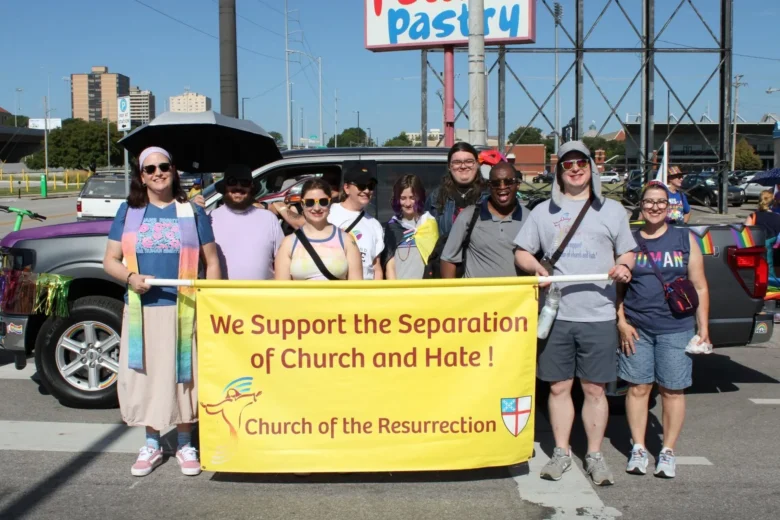
When two North Omaha congregations, one white and one Black, merged to form Episcopal Church of the Resurrection (COR) in 1986, no one knew if it would work. It instantly became the most progressive and integrated place of worship in the Episcopal Diocese of Nebraska.
This blending of congregations and cultures at 3004 Belvedere Blvd. came about by necessity and choice. Forty years ago, three northeast Omaha churches with dwindling, aging memberships – St. Philip the Deacon, St. John and St. Mark – struggled to keep the doors open. With their futures in serious doubt, congregants from the churches discussed the possibility of merging to create a new parish.
All-white St. Mark chose to go it alone. “I always said they would rather die than be part of this, and they did, they died – almost immediately,” said the Rev. Scott Barker, bishop of the Episcopal Diocese of Nebraska, who served as COR pastor in the late 1990s and early 2000s.
That left all-white St. John and all-Black St. Philip to work things out in what some considered an experiment. They navigated fights over identity and ownership and endured lost members en route to finding common ground.
“St. John’s and St. Philip’s could have made the same decision St. Mark’s did and said, ‘No, we don’t want to try a new thing, we like things just the way we are.’ And then we could have had three closed parishes,” said the Rev. Antonia “Toni” Anderson, COR’s current pastor. “But the people came together as one faith community to embrace this huge change and undertaking, and trust the Holy Spirit had something new and good in store …”
Anderson said it doesn’t surprise her that members took the harder, untried path: “The fact they made that decision together, embraced it and weathered the conflicts that arose and came out on the other side is a testament to the resilience of the people who began that work 40 years ago and to the people still doing it at COR today.”
Another past COR leader, the Rev. Judi Yeates, admired how members “worked hard to make it work.”

But it didn’t come easy. Barker replaced an original rector who ran afoul of African American members. A splinter group had organized, alleging racism. A national consultant was brought in to mediate, but to no avail. Said Barker, “I don’t know if it was mere racism that kept that group’s leadership from being welcomed and embraced or whether they were asking for too much in what was meant to be a full partnership.”
Four decades later, Deacon Dorothia Seldon said, “We don’t think of it as an experiment anymore. It’s our church home.”
The chief complainant was a prominent Omaha business owner, which, Barker said, meant “a lot of money, status and power as an important lay leader in St. Philip’s, and some of his friends and acquaintances aligned with him.”
Upon Barker’s arrival, the oppositional contingent had just departed. “I met with a few of those families very early on, and they had washed their hands of the affair. The hardest work had probably been accomplished in that the folks from both previous communities who could not align together had left,” he said. “That had been painful and probably inevitable. But it was done, they weren’t coming back. I didn’t have to fight that battle.”

Still, questions dogged the church. Carryovers from St. Philip included annual Black History Month programming, a fish fry-spaghetti dinner and Soul Food Sunday. Those activities, said member Lesley Dean-Sims, were “making sure African American culture was not lost in the merger – we still needed an identity, and the St. John’s people were willing to embrace that.”
Breaking bread is a baked-in tradition at COR, where lunch is served after every service. Tim and Cheri Oelke have hosted a Labor Day picnic for fellow parishioners going on two decades. COR puts on a yearly block party outside the church. Before entering the clergy, St. Andrew’s priest, the Rev. Keith Winton, attended COR, where, he said, “I learned the great joy of simple meals shared together after worship. I learned community is built slowly, through showing up for one another again and again, in celebrations and funerals, disagreements and reconciliations, workdays and worship, around altar rails and fellowship tables.”

Feeding souls, not bodies, is COR’s stock in trade, but not all messages are delivered from the pulpit. Just off the sanctuary is a striking social justice artwork graphically depicting the horrors of war, lynching and slavery. Artist Leonard Thiessen’s “Crucifixion” triptych was completed in the 1930s. Years later, he donated it to St. John in memory of his parents, who were members. It’s one of many artifacts from St. John, whose building became home to COR. Similarly, St. Philip members brought treasured items to COR.
The church’s integrated ranks not only matched the neighborhood but made it a safe space for some Lost Boys of Sudan who resettled in Omaha.
COR’s identity as a Black praise and worship community was reinforced after Jeanne Rogers became music director. The late Omaha jazz artist brought years of performing experience – not in churches, but nightclubs. Though St. Philip had been unequivocally Black in every other way, music was not one of them. As a “high liturgy” church, it featured traditional (read “white”) hymns. As an all-white church, St. John didn’t sample Black church music. Thus, when COR launched, it was largely the same old, same old. Rogers changed all that.
“We were now not only singing music from the Black church tradition but we had somebody leading it who was a genius,” Barker said. “She brought such giftedness to that performance. It’s hard to overstate what a difference she made. People were like, ‘Oh, this is really good.’”

Rogers, he said, “became part of the community right away. She was great. I miss her.”
The fact that COR had become a Black church in everything but name went unspoken until Barker decided to say so at the pulpit one Sunday.
“Naming Resurrection a Black church felt liberating,” he said. “And it was challenging, especially to the white folks – they didn’t want to hear that. But I think on a deeper level that’s how they conceived of it. It was somewhat controversial. But it was a turning point in finally naming it.”
Nola Jeanpierre sang as a guest artist at COR’s first service in 1986. Two-plus decades later, she was invited to be its music director. She’s still there.

“I’ve been in every kind of congregation and denomination there is, and I found a warmth and ability to open arms for everyone at COR that set it apart,” Jeanpierre said. “When you come in, no matter where you belong, what you’ve been through, what you’ve seen or done, Resurrection is very welcoming and loving. It’s not for pretend, it’s real.”
Under the leadership of Yeates, Barker’s successor, COR outreach efforts responded to high crime, poverty and dropout rates.
“We got into a lot of outreach programs because we looked outside our windows and saw a lot of needs,” she said. “We saw this is what we need to do and so we did it. We opened the doors.”
The needs were so pressing that the church formed a 501(c)(3) C3 nonprofit, CORE, with a budget five times the annual parish budget. Activities included a before- and after-school program at nearby Miller Park Elementary and ESL, sewing, financial literacy and driver’s ed classes for Sudanese refugees that developed into a global mission that went to Sudan, building a girls school there.
Most efforts focused on its own neighborhood. “If we saw people on the corner waiting for a bus in extreme weather, we gave them something hot or cold to drink, along with (bus) passes,” Yeates said. “Housing insecure came for pantries or utilities relief. We began a prison ministry after some of our young men got incarcerated.”

Despite its small size, COR became home to major diocesan programs. Resurrection House hosted interns deciding whether a career in ministry was for them. More than a dozen graduates became priests, including future COR rector Jason Emerson. Former intern Denise Forest opted to teach public school and has made COR her church home. Maggie’s Place was a transition home for formerly incarcerated women seeking to reunite with family.
Today, the Benedictine Way monastery next door partners with COR on a food pantry Tuesdays and Saturdays. COR also partners with neighboring Trinity Lutheran Church on combined services, including an annual outdoor worship service in Miller Park.

Just as COR’s Sunday attendance has declined, from around 90 during Barker’s time to around 40 this last year, so has its Black representation. It remains the diocese’s only Black parish, something Barker says the diocese recognizes is needed. (About 4% of U.S. Episcopalians identify as Black.) COR, a charter member of the social action group Omaha Together One Community, is an island in the diocese both for its racial demographics and liberal stances.
Said Anderson, the current pastor, “Whatever the issue is, I’m never concerned somebody’s going to think my sermons are radical. A lot of my colleagues have to be more careful with their language and worry about not upsetting folks on the other side of an issue. And I just don’t think there are that many people at COR who aren’t on the same side of most issues.”
In a church born from change, the ability to adapt remains a hallmark. The most recent example centers on how the parish has held together during Anderson’s personal transgender journey.
Anderson, who had started conducting services on a rotating basis in 2017 while a curate at St. Andrew’s Episcopal, became COR’s full-time pastor in 2019. Anderson came out to the congregation on Oct. 11, 2023, which was National Coming Out Day, and addressed the topic the next week in the sermon.

“It was a change for everybody,” Anderson said. “They were going through this transition with me in some ways. So it took folks some time to wrap their heads around it and to get used to it, and it took some folks more time than others. But there didn’t ever seem to be a question that people were going to stick around and let me continue to be their priest. I couldn’t imagine personally being in any other parish and coming out and transitioning because I already had a long and healthy relationship with this congregation. I’m incredibly blessed in that.”
Long before Anderson’s transition, COR was an LGBTQ-friendly space, welcoming same-sex couples as members and same-sex marriages.
Barker returned to COR in June to lead its 40th anniversary service on June 14. His sermon that Sunday referred to all its overcome and achieved. More recently, he said, “I think it’s still as powerful as ever as a community that can transform people.”
Parishioner Janice Seldon said she is concerned that COR has but a handful of attendees under 30. The hope is young families will find and repopulate it. Even if they don’t, it won’t go down without a fight.
Said Anderson, “It goes back to the resiliency – the congregation’s willingness to adapt and welcome change in order to continue to survive and thrive.”
No matter how small COR gets, said Dean-Sims, “We’re always going to do what we do.”
The Flatwater Free Press is Nebraska’s first independent, nonprofit newsroom focused on investigations and feature stories that matter.