

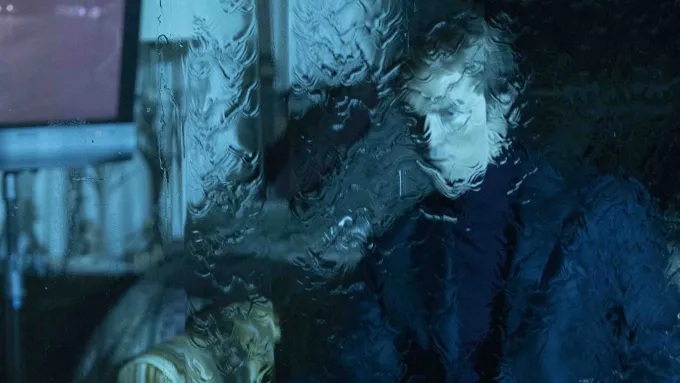
If Robert Pattinson is granted award show adulation for his role as Chris Hansen in Primetime, it won’t be for turning in an uncanny impression of the TV host. It is abstract impressionism at best. It will mostly be for a finger-gunned gesture towards a certain anatomic endowment while silently mouthing a nickname for said part that the Academy absolutely cannot include in their broadcast. That 20-second sequence is a perfect encapsulation of director Lance Oppenheim’s entire film: It is oddly and intentionally funny, remarkably disturbing, and points to things nobody wants to think about.
There appears to be a massive online misperception about the film’s intentions. Can you even believe such a thing?! One accusation is that writer Ajon Singh, working from Luke Dittrich’s article “Tonight on Dateline This Man Will Die,” was vilifying the idea of ferreting out pedophiles and holding them to account. The other is that this is a targeted character assassination of Hansen, whom some still weirdly hold up as some kind of NBC-sponsored vigilante hero. Neither are remotely true, even if the host doesn’t exactly come off as Batman with better lighting.
Instead, the movie works through the ouroborosian closed loop that involves ambitious people looking to exploit the ambitions of people exploiting minors. Objectively, if you didn’t know To Catch a Predator existed in real life, it would sound like a ham-fisted Stephen King short story from the 1980s, right? Primetime is a thoughtful, grainy polaroid of a moment in which millions upon millions of Americans tuned in each week to watch producers lure depraved men into thinking they were about to commit sexual assault.
Hansen (Pattinson) isn’t shown to be a drooling lunatic so much as just a guy who stumbled into a thing that could make him important. Andie Bender (Merrit Wever), who ran the show, is shown to be driven less by a sense of justice than by the thrill and pressure of executing a high-risk production. Dan Plum (Skyler Gisondo), a 20-something actor who pretended to be an underage boy, goes from being a somewhat unwitting participant to ignoring every alarm bell in pursuit of a SAG card. Even Xavier Von Erck (Matthe Maher), who founded the group Perverted Justice, appears to be wrapped up in the gamification of landing deviants like sport fishing.
There isn’t much in the way of plot here. It’s just a brief look at the moment when the show’s rising popularity gave way to the dissolution of moral fortitude, arguably the defining and oft-repeated moment of capitalism. It feels tense and urgent, propulsive despite not having many real story beats. They want the show to be popular. The show is popular. The network wants it be more popular. They have to keep cutting corners.
It culminates in the most infamous actual confrontation but does so without making anyone even slightly sympathize with one of the “targets.” The message driving the film is not highlighted with a neon sign. But interestingly enough, literally every critic’s response complaining that it doesn’t go far enough in out-and-out saying what it should have…seems to have understood exactly what it was saying.
We live in the Netflixification of entertainment, in which themes and intentions must be explicitly spoken onscreen lest audiences “miss the point.” The streaming surge is training illiterate audiences, which in a way is what Primetime is ultimately about. There is a direct line from casual consumption of pedophilia-centric entertainment to embracing a world in which wealthy and powerful people explicitly named in the Epstein files have experienced no consequence. It is not To Catch a Predator’s fault, but it did prime a country into accepting performative punishment as sufficient. Most of the folks Hansen’s team nabbed went free due to how the show was conducted. Weirdly, nobody seems to remember that.
What the show did succeed in doing was priming the pump for Pizzagate and QAnon. It opened the door to spectacle dressed as concern about victims that, in reality, was little more than justice cosplay. This is why Pattinson gives one of the most singular performances of the year. He’s not a rabid villain or a vapid famehound. He’s weird. He’s detached. He’s dissociated from the reality of what is happening in front of him, which mirrors the fallout from the show’s popularity.
Gisondo and Wever are also quite good. The gimmicky aspect ratio, intended to emulate the era’s TV style, admittedly does work pretty well. Ari Balouzian’s score is the right blend of showy and simple. And it has to be said again how frequently it is intentionally quite funny. It’s not disrespectfully mocking victims or the concept of holding their attackers to account. It is highlighting the absurdism and surreality that everyone in America effortlessly embraced.
Primetime enters that echelon of cinema filled with fantastic films that should almost certainly only be watched once. This, of course, excludes the memeification of Bobby Pats. There are short clips from this that will be repeatable a few thousand times. In 2026, that means he wins the Oscar, right?
Grade = A-
Other Critical Voices to Consider
Bhavna Agarwal at India Today says “Where it becomes less satisfying is in how far it pushes its central idea. There are moments when the satire becomes so pointed that the ambiguity begins to disappear. Hansen can feel less like a complicated television personality and more like a symbol of everything wrong with the medium. The film is strongest when it allows discomfort to accumulate rather than telling us exactly what to think about it.”
Justin Chang of the New Yorker says “Oppenheim has persuasively rendered a grotesque phenomenon, but his curiosity seems to stop at how everyone and everything looked. There’s no deeper analytical heft to the movie, no larger curiosity about what To Catch a Predator meant then or what it might mean now, especially in the wake of the sex-trafficking conspiracy theories of QAnon and the very real, still emerging horrors of the Epstein files.”
Glen Weldon of NPR’s Pop Culture Happy Hour says “The more I sat with it after seeing it, the more it kind of curdled on me. And I don’t question that what’s doing is exactly what it sets out to do. It wants to tackle something this lurid, and dark, and emotional, and complicated in a way that’s really lurid, and dark, and emotional, but without any complications at all. It is really stripping away any nuance.”