

If you want to know how improbable it is that a documentary has become the buzziest, most meme-tastic movie currently rockin’ cineplexes, my father literally stopped me when I said “I just saw a three-hour documentary” because he was simply too disinterested to let me continue.
Cringe comedy can be painful poison, so I have not been a disciple of the church of Nathan Fielder. True crime is not my bag, so I only had passing interest in Elizabeth Holmes’ cautionary tale about rich people enamored with big-promise-low-proof tech, which – speaking Anthropically – has gone wholly unheeded. My low-level interest in You Can See Everything was solely because she scammed Henry Kissinger, an accomplishment that maybe should come with a “get out of jail free” card.
In addition to all of that, I couldn’t see it opening weekend. This meant nearly a full week of almost everyone I know in real life and absolutely everybody I mistakenly think I know on the Internet burying me in hype about the film. It seems palpably impossible that I could be satisfied by a satirist I do not know telling a story about a person I do not care about that everyone has told me is perfect.
I’m going to assume you know where this is going.
How the hell is this the best movie of the year? It makes absolutely no sense that almost literally everyone who sees it comes away enraptured. I am going to do my best to unpack how and why without any spoilers, and yes this is one of the rare documentaries that has those.
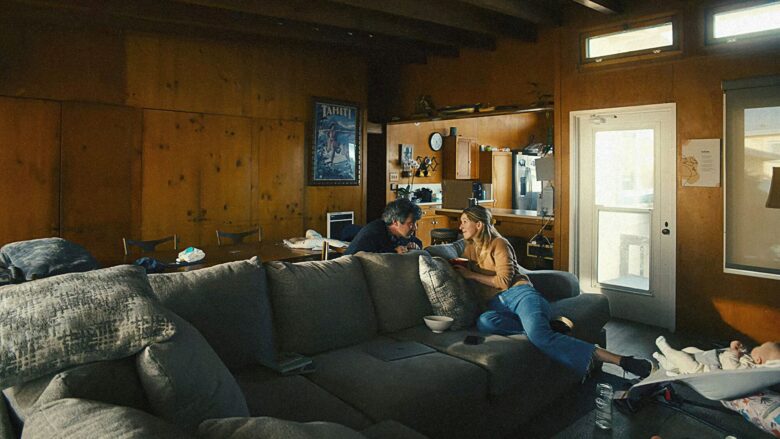
Fielder was granted insane access to Holmes and her partner Billy Evans in the days leading up to her starting an 11-year prison sentence. The whole thing basically amounts to what you have seen in the trailers: Fielder asking Holmes questions to which she gives brain-melting responses. It’s that and Billy being essentially an upsettingly serious version of Jean-Ralphio from Parks and Rec.
The first two of the three hours is the buildup to her incarceration. The third hour is something else entirely, which shan’t be broken down here. It’s not that knowing what happens would “ruin” things so much as it feels more compelling and intimate to slowly walk through Fielder’s process and get to where things end up.
There is a scene in this movie that I will inarguably think about for the rest of my life. Several, probably, but this one in particular involves the Abbot and Costello routine “Who’s on First?” That sequence is the key to unlocking the movie’s entire genius, as it makes evident that this whole thing is (A) a Rorschach test about how you see the world, (B) a meditation on manipulation, (C) a masterclass in artistic literacy, (D) a thorough critique of relationship dynamics and gender roles, and (E) hilarious.
The score by Ari Balouzian and the cinematography by David Bolen are straight out of a horror film. Sometimes Fielder is framed like Michael Myers; other times he is the victim. The moments when Billy bubbles and hisses like an impotent volcano are tense but never scary. The implications are terrifying.
You are invited to decide whether Holmes is a master manipulator or a victim. You are also explicitly asked to question whether Fielder is being honest in how he is presenting the evidence. You are also shown, demonstrably, that Billy sucks so, so much. Just so much. Like, an impossible amount.
Different conclusions will obviously be reached, and none can be objectively “right.” But what feels the most likely (to me) is that Holmes is both things: a schemer and a pawn. What she is not, at least in my perception, is a victim suffering from a “different way of thinking.” Billy is controlling and a pro-tier gaslighter, but Holmes hums those same tunes. They are planetary-scale narcissists orbiting one another in a ghastly symbiosis.
Whether or not Fielder was actually charmed into at least considering the most charitable interpretation of the facts surrounding Holmes is unknowable. But he has strewn the cinematic ground with enough obvious breadcrumbs to make it clear he does have an agenda. At least in part, that agenda is to make everyone in the audience fully examine their biases and experiences.
Even the title You Can See Everything is a miniature masterwork packaged as tightly as Hellraiser’s puzzle box. Maybe it is as simple as this: America, if not the world, has been so thoroughly cleaved in twain. Every fact and feeling seems to exist in push-pull opposition. To live in the gray for three hours, to be urged to pontificate on the unknowable and consider the rounded edges of the truth offers something oddly like peace.
One final, unbelievably fitting note. The codirector of this movie, Lance Oppenheim, was recently accused on various social media forums of…stealing the work of others in the short film that gave him his big break. There has been quite a back and forth about the claims, which only serves to further demonstrate that questions about crimes of omission, deception, and manipulation are ones each of us are going to have to answer.
Grade = A+
Other Critical Voices to Consider
Candice McMillan at Seattle Refined says “Fielder has created a shape-shifting narrative that offers both sides hefty evidentiary support to back up whichever fork in the track riders may choose.”
Allyson Johnson at In Between Drafts says “Laugh at this parade of madness as the filmmakers and their friends try to come to terms with the film they made, the questions left unanswered, and what it means to question your own take on a subject seemingly closed.”
Jeanine T. Abraham at VisAbleBlackWoman says “I would classify You Can See Everything as performance art grounded in the idea of documentary filmmaking, and when you go a little deeper, it’s an intimate look inside the mind of a skilled scammer.”