

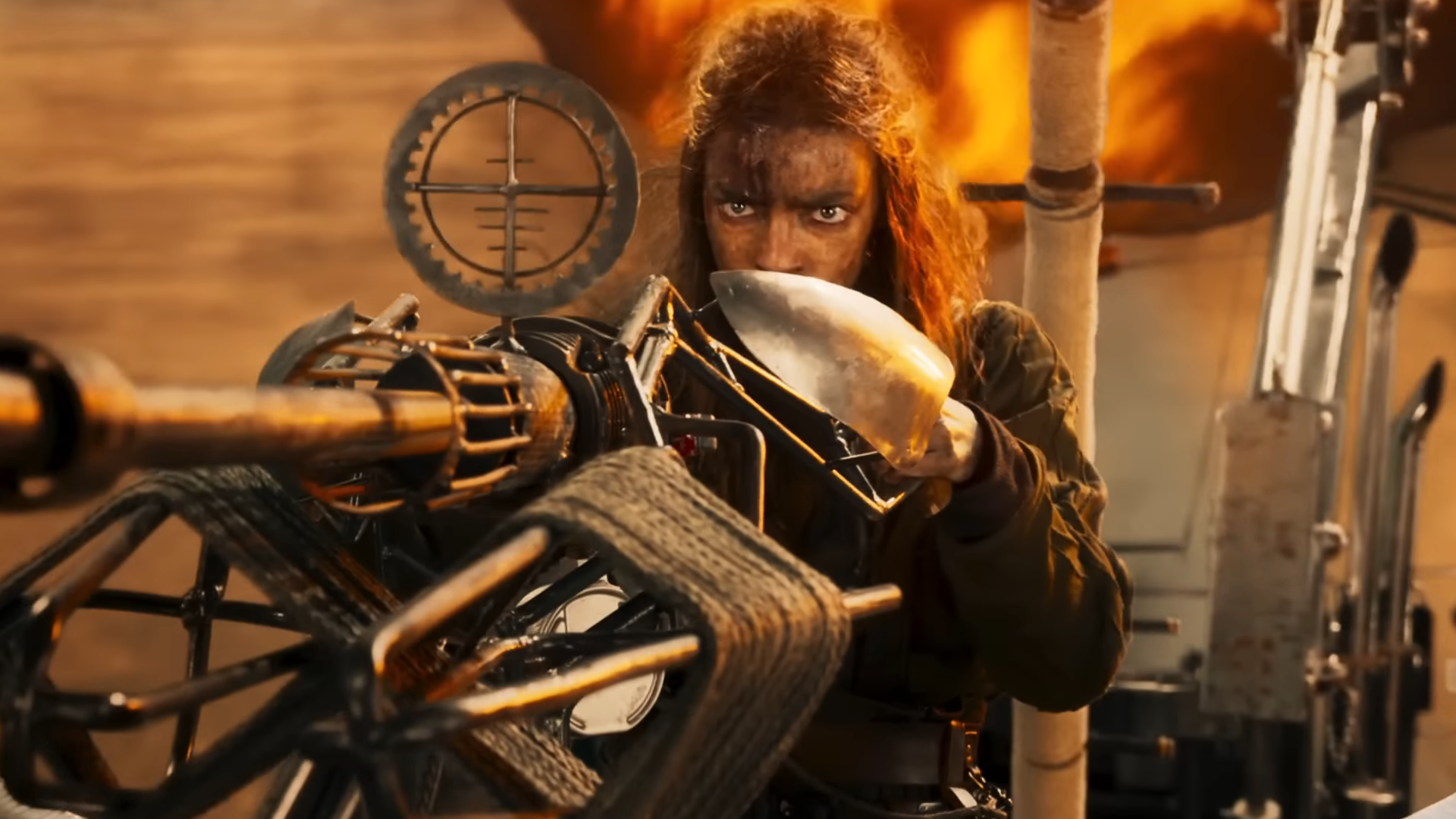
Up there with jorts and capitalism, prequels are among the worst ideas of all time. Why would the lunatic near-octogenarian George Miller (Happy Feet) make Furiosa: A Mad Max Saga, a film set before Fury Road, when he could make the next chapter, The Most Furious Road: Who Needs Mad Max?
Prequels have always felt like lazy cheating, either re-squeezing old ideas for the last of their milk or making up for previous filmmaking flaws. Fury Road is perfect and needs no revision. There will be no arguments to the contrary. The assumption was that Furiosa would be a double-dip. Still, what madman would say no to more vehicular mayhem?
Shockingly, Furiosa isn’t more of the same. Fury Road is all gas, no brakes. Furiosa is someone learning to drive stick, all herky-jerky in its exhilaration. Fury Road is a delightful feminist cudgel, a surprising twist for a series previously led by noted non-feminist Mel Gibson. Furiosa doesn’t have much of a bigger point, beyond the unneeded further condemnation of the gross and bad things man can do. Fury Road is a masterpiece. Furiosa makes that masterpiece better. It is arguably the most effective prequel ever made in that regard. And had it come first, neither film would have been as good. What a weird, wonderful pair these two make.
All we knew of Furiosa’s story previously was enough. But everything gets spelled out here: As a child (Alyla Browne), she is kidnapped from a splendorous oasis run by women, an Eden in the middle of the postapocalyptic desert. She is taken to Dementus, played by Chris Hemsworth’s prosthetic nose and also Chris Hemsworth. Fury Road’s main baddie, Immortan Joe (Lachy Hulme), is back. Joe is a demonic dictator, while Dementus is a carnival barker and agent of chaos. He is purposeless evil, inflicting suffering for lack of a better outlet for his toxicity. He’s basically why professional sports exist.
Baby Furiosa escapes, pretends to be mute and a boy, grows up to become Anya Taylor-Joy, and falls in with Praetorian Jack (Tom Burke), who is essentially Mad Max if he saw a therapist. Pleasingly, Jack doesn’t so much “teach the young lady how to do cool murder and car stuff” so much as “recognizes this young lady can do cool murder and car stuff” and enables that. He’s a good dude in a bad place. Dementus chooses cruelty to escape nihilism, but Jack chooses kindness. Furiosa’s choice is revenge, perhaps the least interesting and most overused motivational device. She wants to kill Dementus and his goons, who are pretty busy starting an all-out war with Immortan Joe’s legions.
Furiosa makes it inarguable that Fury Road is actually the bald bad-ass’s movie, not that anyone was arguing much before. What’s remarkable is how this prequel enhances the thematic weight of its predecessor. It’s not answering useless questions or providing needless details, no midi-chlorians or trade disputes to be found. Even the obligatory “how did Furiosa lose her arm” pours guzzolene on her emotional fire. The most astonishing thing is the way in which the film feels…necessary, the absolute highest compliment a prequel can be given.
It has pacing problems, sure. Taylor-Joy is but a shadow of Charlize Theron in the role. Hemsworth’s schtick is hit-and-miss. But it is unique among its kind, in that it is a prequel with an actual purpose. So how do you rate movie that improves a masterpiece but couldn’t possibly stand alone? You rate it pretty damn highly and rewatch both. Often.
Grade = A
Other Critical Voices to Consider
Siddhant Adlakha at Mashable says “It not only rivals Fury Road but surpasses it in several ways, especially as a soul-stirring character drama steeped in loss and anger, a potency it translates into motion and momentum.”
Walter Chaw at FilmFreakCentral says “The greatest irony of this and other recent zeitgeist touchstones (Dune Part Two, Civil War, Oppenheimer, Godzilla Minus One) is how our most ambitious popular art, our desire to create precious things (still the best defense for our continued existence), is primarily dedicated to documenting what feels like our final years on a dying planet. The last flare of a guttering flame, perhaps. But there’s so much life in Furiosa that I felt hope for the first time in a while, because the world is still a beautiful place. There are still artists filled to the brim with magnificent brio. If they’re still fighting, maybe it’s all still worth fighting for.”
Jen Yamato at the Washington Post says “We already know that Furiosa’s quest will end, eventually, in a reclamation of hope; in Furiosa we see how long it has taken her to travel that road. But we can also imagine she’s not the only one out there finding purposeful rage, salvation and a new beginning in the Wasteland.”