

I really set myself up for this. The day before I saw Wild Horse Nine, I had a conversation about the pit I get in my stomach when I have to review a movie that is masterfully made but totally misses me. Whenever that happens, I avoid writing it up nine times out of 10. Wild Horse Nine is that tenth time.
Writer/director Martin McDonagh’s obsession with toxic and fraught male friendships, often betwixt total jagoffs, has never sat fully right with me. Among the many things that tire me pop culturally, being asked so frequently to root for and care about bad people is inarguably the most exhausting. Note that I didn’t say “flawed people.” Rooting for wholly good Boy Scouts is a drag. But time and again being invited to provide pity and pathos for poltroons is pretty punishing.
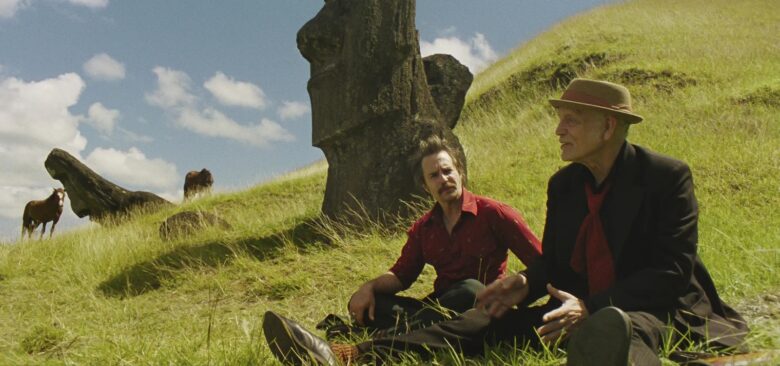
Chris (John Malkovich) and Lee (Sam Rockwell) are CIA agents fomenting a Chilean uprising in 1973. Chris is dying. He has mere days left before cancer takes him. Lee, his only friend, agrees to pause the political turmoil that they’re working on in order to join him on a trip to Easter Island.
MJ (Steve Buscemi) doesn’t want Chris to die before turning over some incredibly crucial evidence about an incredibly controversial assassination. He leverages Lee’s wife (Parker Posey) to secure his involvement. The rest is all McDonagh’s signature solemn-but-snappy banter, like Aaron Sorkin by way of Friedrich Nietzsche.
The primary butt of the joke in Wild Horse Nine is American interventionism, which is a perfect target. But something about it feels off (to me and me alone). Contrast this with anything Armando Iannucci, and it immediately pales by direct comparison.
Maybe it’s McDonagh’s dominant tone of mean-spiritedness? Maybe it’s because the film still asks you to feel broken-hearted for the trouble-makers, whereas Iannucci casts them all as deplorable clowns? Maybe it’s that the use of era-appropriate stabs at political correctness come off as tone deaf? I can’t know. And believe me, I tried.
Malkovich, Rockwell, and, in a much smaller space, Buscemi are all fantastic. And yet they are all vamping on the typical and wholly expected Malkovich, Rockwell, and Buscemi approaches. They’re all good. Quite good! There are just no surprises to be had.
The same is true for the plot, which is quirky more than interesting and establishes every single person but one as reprehensible. To keep things spoiler-free, I can just say that the one redeemable person is taught a lesson about the futility of goodness and the ultimate bleakness of the world. Chris delivers advice to said character that boils down to “there is no good in anyone, you should kill everyone you see if you want a better world.” And then he is proven right.
That’s where the whole thing rests: Wild Horse Nine is yet another film from an unquestionably talented writer/director that slots squarely into his bleak, horrifyingly sad world view. It is what he set out to do. And he did it. Again. I am just so tired of consuming it.
I don’t know how many times I can be asked to muster meaningful sympathy for terrible people. Pithy punchlines and clever turns of phrase sort Wild Horse Nine into a dark comedy. But asking us to (again) feel sorry for the figures lurking in the dark, to forgive those who made it dark, and to accept that the world is unchangeably dark has (again) pushed me too far afield.
It is a drum-tight, well-crafted affair that hits the bullseye it aimed at. And I didn’t like it much at all.
Grade = C-
Other Critical Voices to Consider
Justin Chiang at The New Yorker says “You can’t accuse McDonagh of not knowing his priorities; we are to shed bountiful tears for Chris, with perhaps a few to spare for his collateral damage. Some of us may be forgiven for resisting the invitation. I remained dry of eye—and rooted for the cancer.”
Sarah G. Vincent says “Wild Horse Nine is McDonagh’s take on the neo-Western except instead of being set in the Western part of the US, it is set on the world stage through the microcosm of a tourist site that once was sacred when Western values did not touch it. If it sounds heavy, it was not obvious while watching.”
Sarah Gopaul from Imagery at the Movies says “The film is a sharp comedy that lives for the clever and enthusiastic exchanges between the acclaimed cast. McDonagh has a knack for these nimble, character-driven pictures, as well as not letting the scenery remain simple background.”