

There is a novella’s worth of text put on the screen at the opening of Strange Darling, each piece more maddening than the next.
The first text shown says the movie was shot entirely on 35mm film. This is equal to a musician starting a song by telling you the brand of synthesizer used. Neat.
The second text shown is an overlong preamble that claims this is a retelling of the last days of a real-life serial killer, which is a lie. That deception would be fine but the language is annoying Trumpian hyperbole, claiming it follows “the most prolific and unique American serial killer of the 21st century.” Huge. Killings like you’ve never before seen. Not since the late great Hannibal Lecter has there been such bigly murders.
The third text shown involves the opening credits, which introduce the performers and the characters they play. Reader, I had the overpraised “twist,” the “clever” surprise, figured out by the end of said credits. This is not because I’m some genius savant, but because the misdirect is so obvious as to be violently obnoxious. That’s fitting, as Violently Obnoxious should be the name of this insufferable, infuriating abomination. More spoiler-free condemnation to follow, read on!
The fourth text shown finally gives the title and informs audiences that this is a “thriller in 6 chapters.” If you don’t find that construction grating enough, the fifth text shown tells us that we’ll be starting with “Chapter 3: Can You Please Help Me?” Monkeys on typewriters and mathematicians working theorems would have to bang at keys and slap chalk on blackboards for 10,000 years to find a more irritating sequence of words to open a movie. It is a student film on steroids, and the school is in hell.
Although the admonition “Don’t yuck someone else’s yum” is empathetic and kind advice to which I try to adhere, writer/director JT Mollner’s Strange Darling forces me into an exception. I don’t wish to have not seen Strange Darling. I wish for it to not exist. Were it in my power to unmake this self-important, cruel bit of fetishized misogyny, I would disappear it in a heartbeat. I would neither hesitate to make that one of my three wishes from a genie nor ever regret having wished it. The worst part is that I can’t tell you precisely why.
That’s because while I will violate my anti-yum-yucking policy, I won’t spoil a movie in a review. I simply won’t. I found out Santa wasn’t real because of a Punky Brewster write-up in TV Guide. If you just found out Santa wasn’t real from this review, feel free to declare a blood feud with me. Here’s all I can say about the plot of Strange Darling without revealing anything.
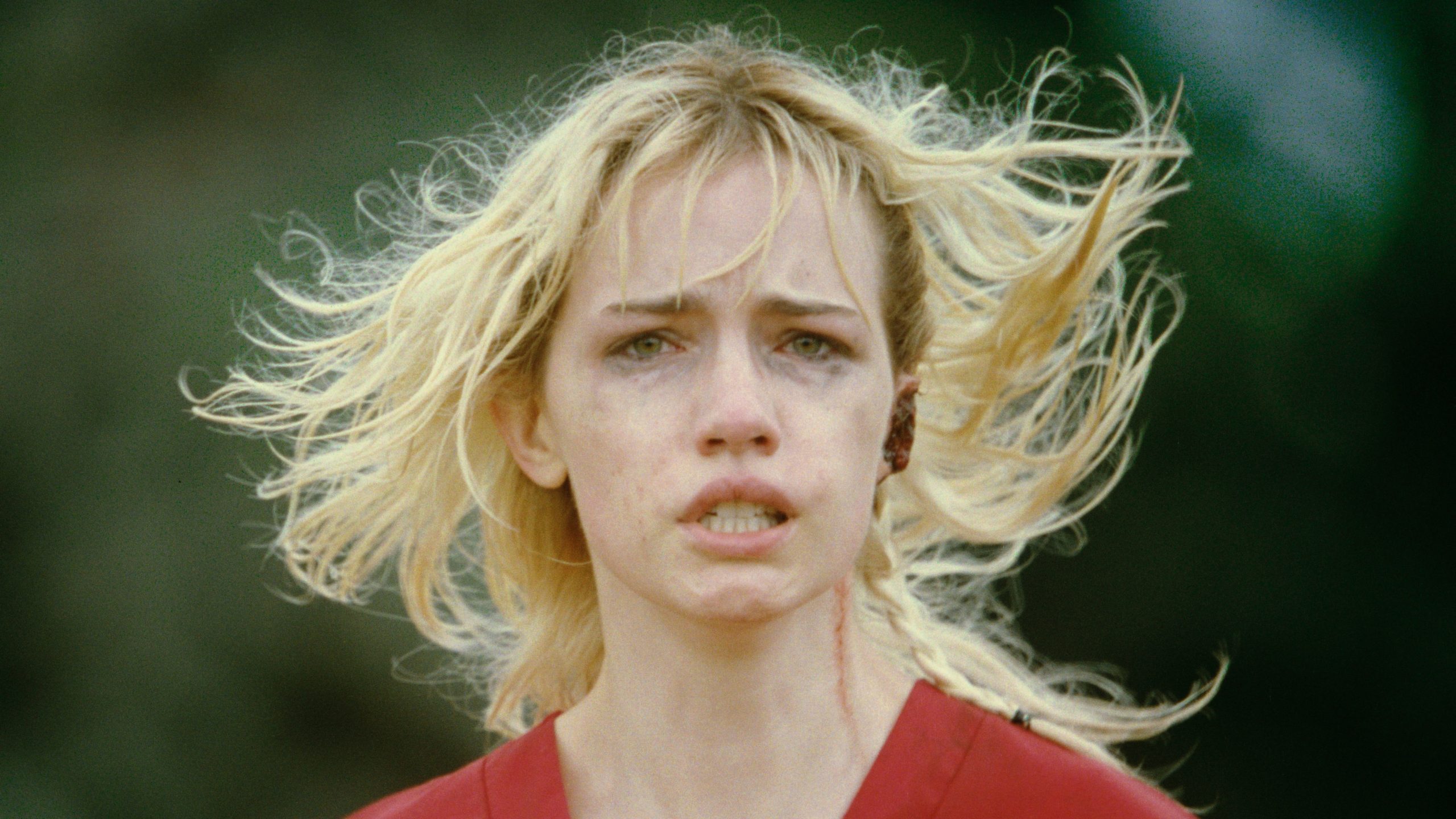
Actress Willa Fitzgerald spends the near entirety of the film in some state of suffering. Others are harmed too, sure, but she is brutalized from the first frame to the last. The surprise twist constitutes the entirety of the plot. That’s all there is. And were it not doggedly, blatantly, horrifyingly mean-spirited, it would simply be lame.
But it is doggedly, blatantly, horrifyingly mean-spirited. I can maybe understand how people could squint through the first three-quarters and come up with a justification that supports a misguided feminist lens. It’s a bad take, but I could see how they reasonably get there. The last 15 minutes contains a sequence that simply will not allow any other reading of the film than anti-woman.
Strange Darling is ugly. Not visually, it’s actually well shot (ENTIRELY ON 35MM). I’ve never been one to confuse cruelty with cinema, but nasty films can have merit. This has none. If you were to distill everything I detest about movies into liquid form, this would be the resulting hateful milkshake. I do not want to drink your milkshake. I do not want to drink it up.
Grade = F-
Other Critical Voices to Consider
Katie Rife at RogerEbert.com says “J.T. Mollner’s self-consciously edgy gotcha of a serial-killer thriller, is so high on its own cleverness that it never stops to think about what it’s actually saying. A pithy way to summarize this movie’s whole vibe would be ‘If Quentin Tarantino tried to make a #MeToo movie.’ But that’s not fair to Tarantino, who, for all his flaws, is at least somewhat self-aware.”
Lauren Bradshaw at Fangirl Freakout says “With its topsy-turvy script, award-worthy lead performance from Willa Fitzgerald, and stunning, atmospheric cinematography from Giovanni Ribisi, this film deserves the hype.”
Jeannette Catsoulis at The New York Times says “Playing out in six, ingeniously scrambled chapters, this headlong thriller transforms a simple cat-and-mouse premise — and maybe even a toxic love story — into an impertinent rebuke to genre clichés and our own preprogrammed assumptions.”