

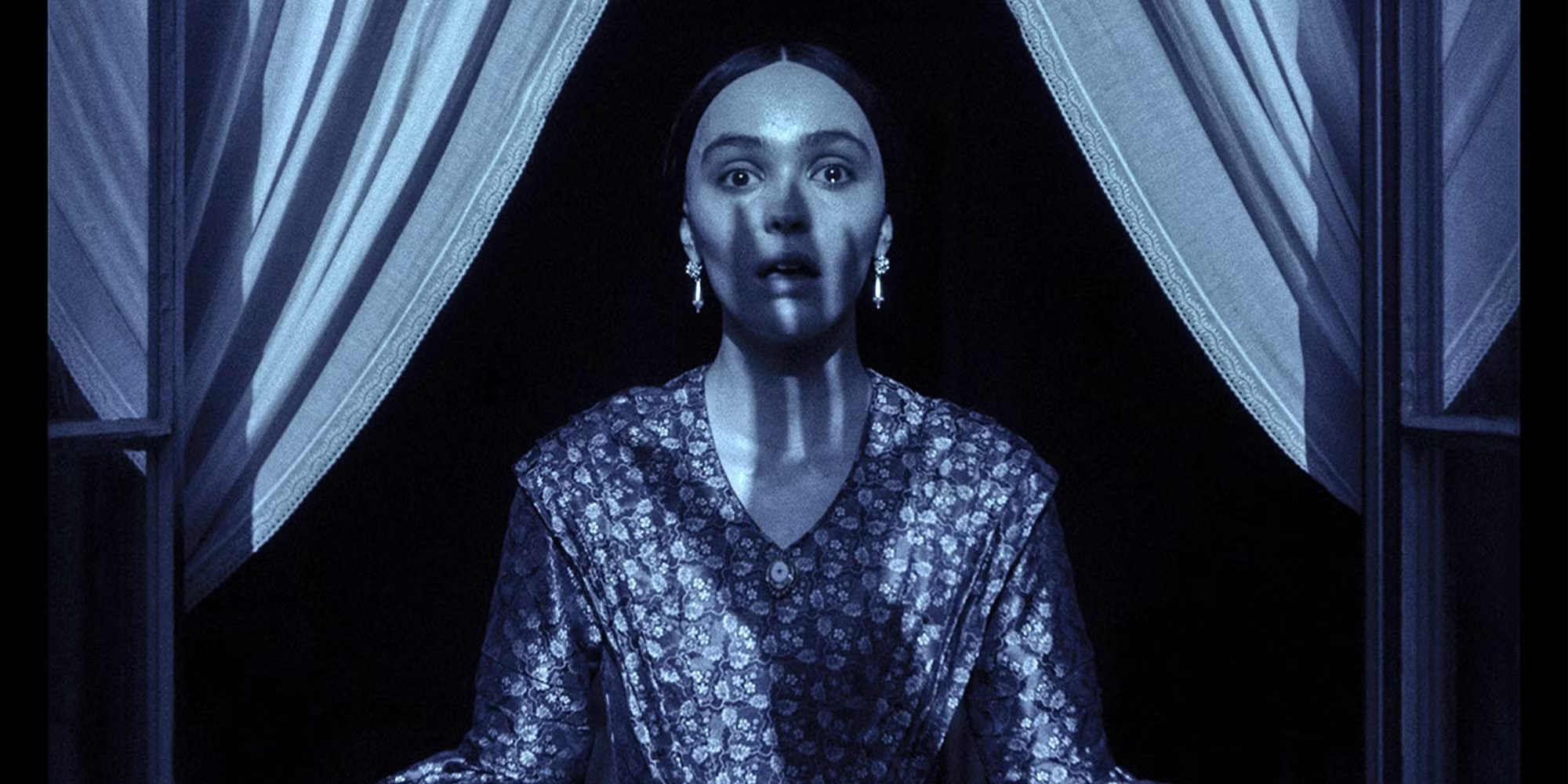
In an interview with Variety, writer/director Robert Eggers tried to explain why the villainous vampire in his inert, dull, needless reboot of Nosferatu looked so dumb. He told the magazine that he tried to envision how an undead Transylvanian nobleman would actually look. “No matter what, there’s no way this guy can’t have a mustache,” he concluded. So, there you go: A real Hungarian vampire would have a big bushy state trooper mustache. That’s just facts.
I haven’t liked a single one of Eggers’s films. Huzzah to those who do, may we part in peace. The very things others hold up as virtues, I see as grating vices. His much-praised use of darkness and shadow? Call me a kook, but I like to see the movies I see. His obsession with historically accurate details in his films? I don’t care if that’s how the roof was really thatched, your story sucks. His use of “erotic” to describe films that have varying degrees of sexual assault? We do not agree on what that term means.
I also have not understood what he is even trying to say with most of his oeuvre, in particular with Nosferatu. It could have been some kind of plague-era reckoning for a world that still rigidly refuses to admit that the COVID pandemic broke our brains. Imagine a parable about embracing a hallucinatory, unholy explanation for real-life suffering instead of…whatever Eggers did here.
A doggedly faithful retelling of the “original” vampire tale, Nosferatu centers around a real estate deal. But it’s a spooky real estate deal! Ellen (Lily-Rose Depp) and her new husband, Thomas (Nicholas Hoult), haven’t been married long enough for all the secrets of their past to come to light. He’s a bit of a workaholic. She entered into some kind of pact with an unholy beast. Newlyweds, am I right? Thomas gets dispatched to finalize the sale of a property to Count Orlok (Bill Skarsgård), who has a dumb but very accurate mustache.
Turns out, Orlok is bad news. He begins torturing and tormenting Thomas, Ellen, and then a bunch of others. Friedrich (Aaron Taylor-Johnson) and Anna Harding (Emma Corrin) get sucked in (get it?!), and Professor Albin Eberhart von Franz (Willem Dafoe) tries to help thwart the vampiric plans by reading a book that tells him what is going to happen. Got em! There is also a plague and many rats, if you’re into that stuff.
There’s also a lot of upsetting sex stuff. No doubt, Eggers would point to the source material or history, as though powerless to change any of it. Definitely don’t question why you’re drawn to it or acknowledge that your decision to recreate it is exactly that: your decision. Like The Lighthouse, The Northman, and to some degree, The VVItch, the effusive praise Nosferatu has gotten from many completely befuddles me. Countless critics have hailed it as terrifying (it isn’t), said that it redefined the vampire (only if the mustache thing sticks), and celebrated it as beautiful (I could barely see it).
Yet another of a very particular kind of cinematic auteur leaves me bored, cold, and unintentionally amused. If Eggers is your jam, get to boogying. Just wake me up when it’s over.
Grade = D
Other Critical Voices to Consider
Xero Gravity at Horror Press says “This is mesmerizing filmmaking across the board. Eggers loves to take it slow, which I normally don’t love, but to keep it a buck, I was entirely too enchanted to care about a 132 minute runtime. Even if gothic romance ain’t your bag, you won’t be able to lie on the amount of beauty and care. Happy holidays, and fear the Count.”
Walter Chaw at Film Freak Central says “Eggers’s Nosferatu honours its Expressionist roots with sets at war with right angles, with aggressive chiaroscuro so distinct that light and shadow become almost tangible dance partners with the characters, with enthusiastic depictions of nightmares and hallucinations that make vapour of the border between reality and dark fantasy. It’s absolutely ravishing.”
Katie Smith-Wong at Flick Feast says “In his aspiring vision of Nosferatu, Eggers plays on the senses to add a layer of discomfort while drawing the audience into his spell. There are deep and guttural blood-sucking noises and sparsely lit corridors. The smart use of shadows creates an unsettling feeling of what danger is lurking in the darkness.”