

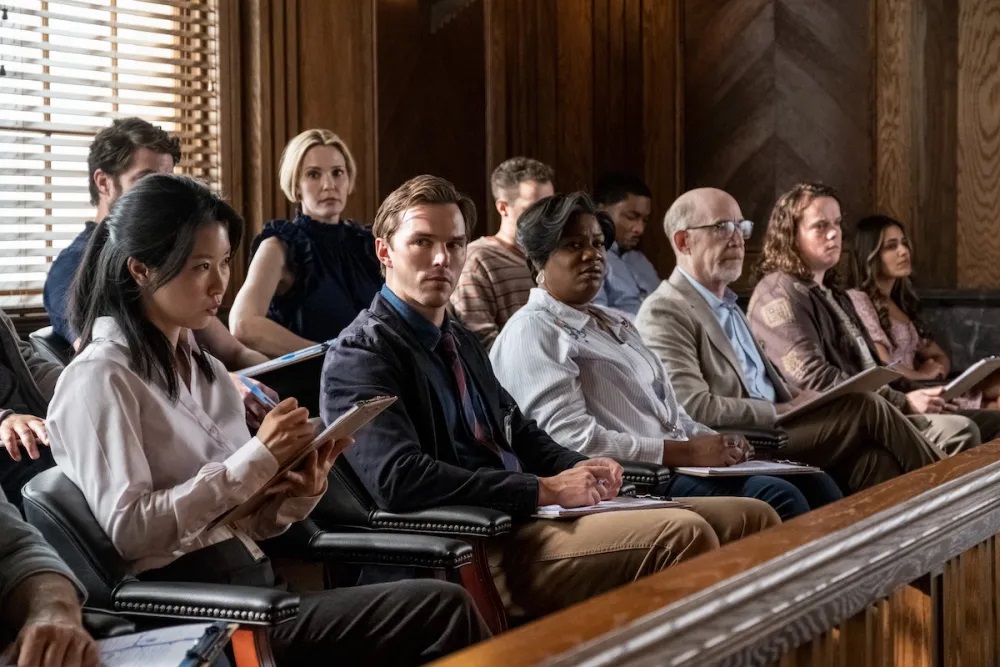
Clint Eastwood, Methuselah’s older brother, has directed a new movie that has pretty much gone direct to home streaming. This is a shame because Juror #2 is borderline great and would have benefitted from the claustrophobic atmosphere of a theater. Being stuck in a room with strangers whose opinions you probably detest is both the conceit of the movie and how it feels to go to one.
This is, above all else, a movie for adults. No, not that kind. It’s the kind where there’s a plot and characters, where people talk to each other a lot. There are “decisions” and “consequences,” and pretty much every part is played by a damn fine, well-known actor. Yes, that is Kiefer Sutherland giving legal exposition in two scenes. You’re right, that is J.K. Simmons as a flower shop owner with a secret.
Secrets are at the heart of Juror #2, a film that posits maybe there’s no such thing as a good person. Justin Kemp (Nicholas Hoult) appears to be. He loves his very pregnant wife (Zoey Deutch) and dutifully presents when summoned for jury duty. Just one problem. During the opening statements by the prosecutor (Toni Collette) and defense attorney (Chris Messina), Justin realizes that the guy on trial didn’t kill his girlfriend. He couldn’t have. Because Justin did.
Oh, it was an accident. Technically, it was a hit and run, but the movie goes out of its way to show that not only was Justin in a horrible emotional place that rainy night, but he did try (kinda) to do the right thing. But will he now? Can he? Given his history as an alcoholic, now several years sober, nobody would believe it wasn’t drunken vehicular manslaughter. The guy on trial is, by all accounts, a grade-A monster. So, what’s a Justin to do?
Writer Jonathan Abrams has a fantastic conceit here. What makes it work though is that you aren’t sure how you hope things will go. As audiences, we always sit in judgment of the characters on screen. We cannot influence their actions, but we can condemn or embrace them. The moral quandary here is a juicy one, a real spicy meatball. Sorry, there’s something Italian in the air surrounding problematic murders these days.
Hoult is perfect, inviting sympathy and disgust in equal measures. As the votes in the jury room flip and swap, so too does the audience’s support for the soon-to-be-father. The script doesn’t have complex, ridiculous twists and turns. In fact, it hinges on the very real problem of police not actually doing the job they’re paid to do. It’s all preposterous but believable, and everything gets hammered out with talking.
Talking is great. Seriously, it doesn’t get enough credit. Yes, yes, cinema should “show, not tell.” But words are fantastic, and watching good actors trade them back and forth can be a hell of a thing to watch. Juror #2 feels like a movie that would have been a colossal hit 30 years ago, during the heyday of John Grisham. Something about being around a Clint Eastwood movie for a few hours sure does make you want to yell about the good old days, doesn’t it?
Grade = B+
Other Critical Voices to Consider
Jared Mobarak at Hey Have You Seen…? says “There are a lot of damning moments within this film (and inspiring ones considering some unlikely sources choosing to do right), but the one that sticks with me most is the star witness’s face quickly turning from indignation to fear when asking, ‘He did do it, right?’ days after declaring it under oath.”
Justin Chang at NPR says “Eastwood may take his characters to task, but he also sees the bigger picture. He’s long had a skeptical view of institutions and their failings, whether it’s a corrupt police force in Changeling or the manipulations of the media in movies like Sully and Richard Jewell.”
Aglaia Berlutti at El Nacional says “Justin is not only part of the apparatus of the law. He is also a twisted symbol of the search for good and the possibility of error in a fallible system. The director, who concentrates on long silences and dark close-ups, makes it clear that his film, which is probably the great farewell to the world of cinema, is more interested in the darkness of men than in the possibility of redemption.”